Go/No-Go release checklist: criteria and a template you can copy
A Go/No-Go checklist for software releases: the criteria that matter, who makes the call, examples of No-Go conditions and a template to paste into your release ticket.
AI QA for startups: Claude agents write, run and maintain your web, API and mobile tests. A human QA engineer reviews every change and signs the release call. One flat monthly price.
Release 1.8.0 · Go/No-Go
GOSigned by the QA engineer. Shipping stays your decision.
Watch
What we do, how a release gets its Go or No-Go, and what it costs.
The player loads from YouTube only when you press play (what that means). You can also watch it on YouTube.
The problem
Small teams ship fast. Without someone who owns quality, the same four things happen.
What you get
All of it is part of every month, for web, API and mobile.
We map your critical user flows and the ways they can fail, then agree what to test first and how deeply.
Web tests in Playwright + TypeScript, API tests, and mobile tests in Appium, Maestro or Mobilewright. They live in your repository and run in your CI.
test('checkout with a saved card', async ({ page }) => {
  await page.goto('/cart');
  await page.getByRole('button', { name: 'Pay now' }).click();
  await expect(page.getByText('Order confirmed')).toBeVisible();
});Tests are updated when the product changes. A flaky test is traced to its cause and fixed, not muted.
New features get hands-on testing by a person, not only scripted checks.
Every bug comes with steps to reproduce, expected and actual results, and evidence such as screenshots, video or logs.
What was tested, what failed, the open risks and a clear recommendation, signed off by the QA engineer. Shipping stays your decision.
Questions and updates go to your team's chat: a channel in your Slack, Discord or Telegram, or a seat in your workspace, in your time zone.
How it works
Claude agents do the repetitive test work and a human QA engineer reviews every change. You see each step in your own chat.
01Week 1
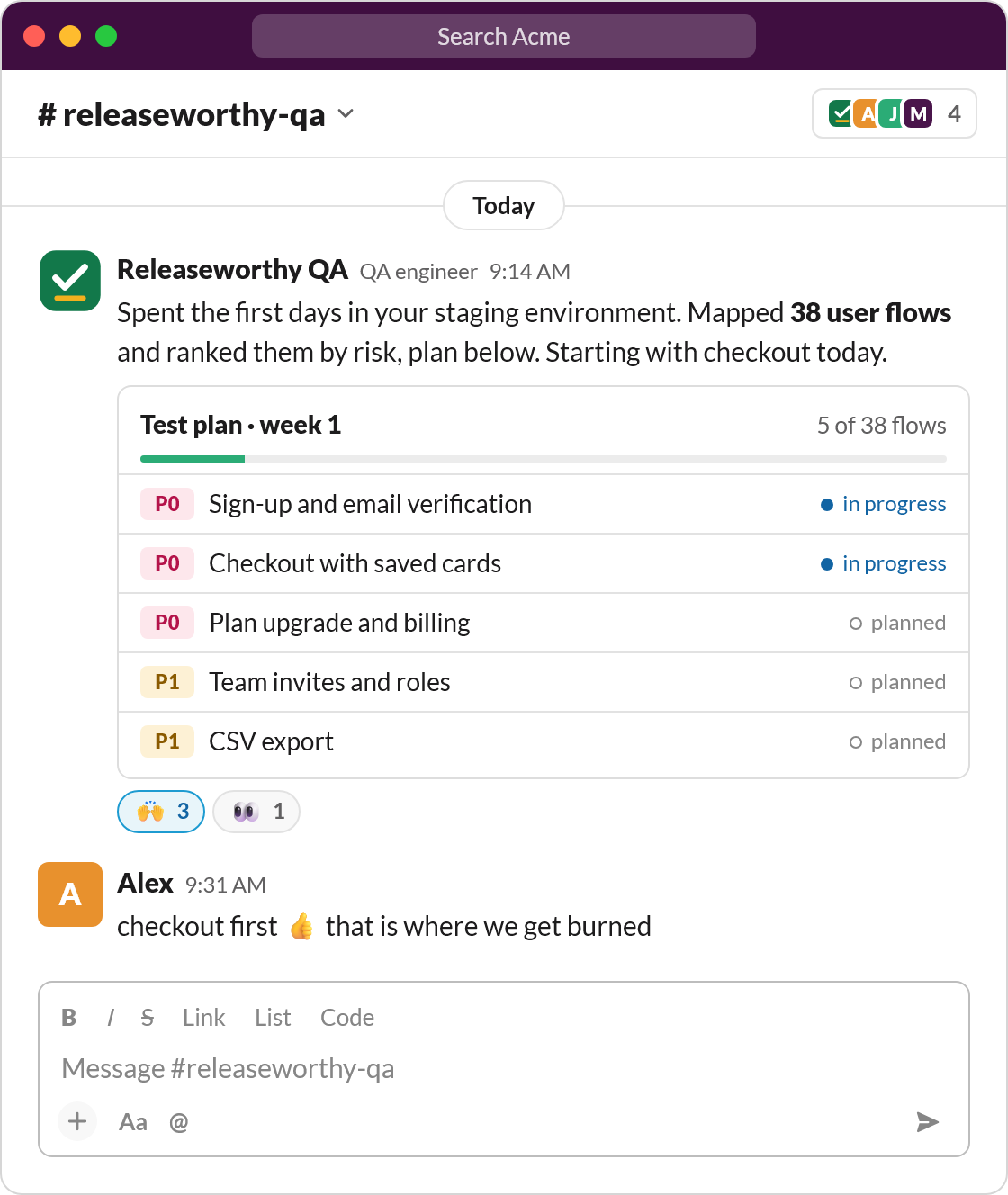
You share a test environment, test accounts and access to open pull requests. The agents explore the app and draft your user flows; your QA engineer ranks them by how much a failure would hurt and agrees the plan with you, in your own chat.
02Weeks 2 to 4
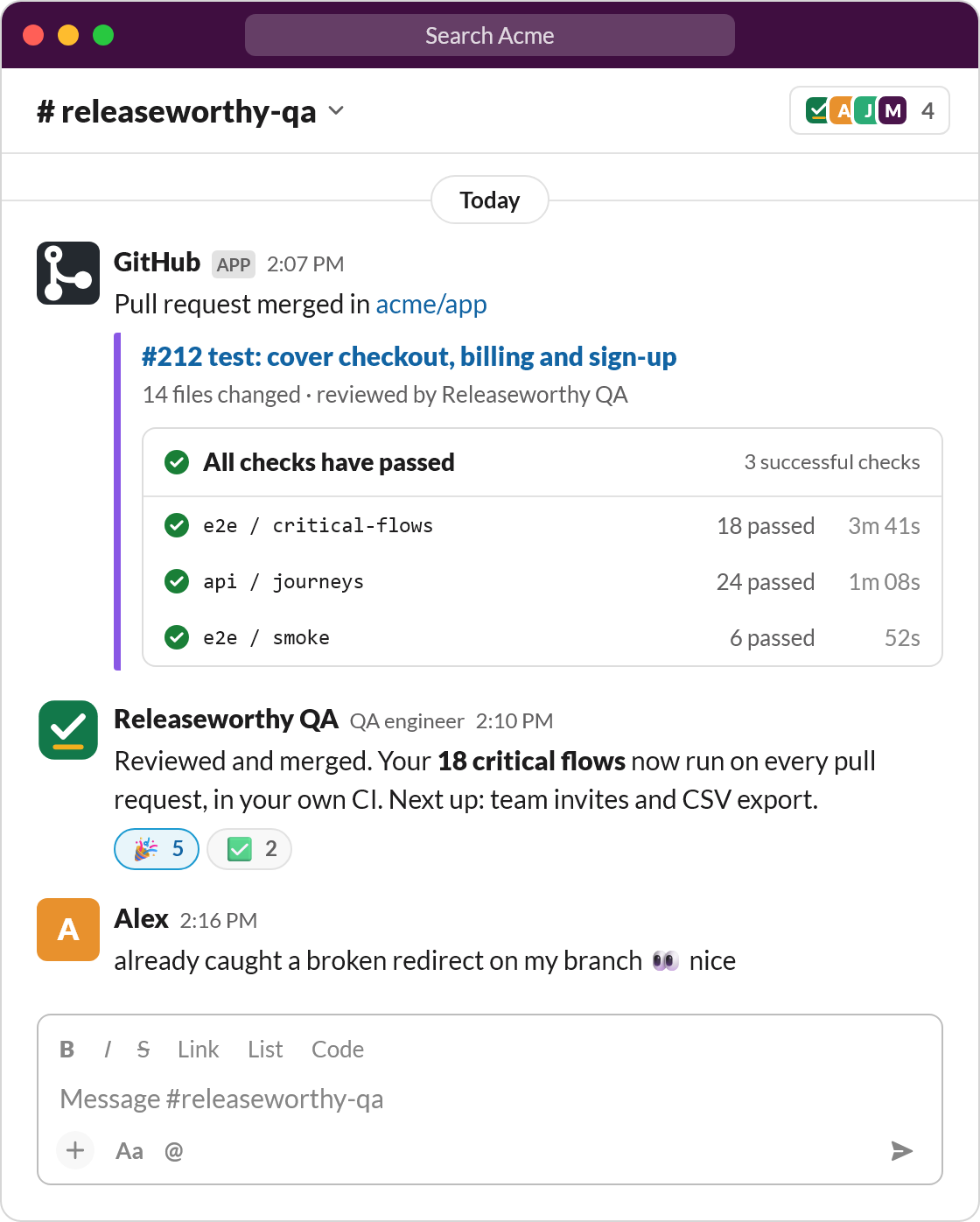
Tests arrive as pull requests in your repository, in plain Playwright and TypeScript. Your QA engineer reviews each one before it merges, and from then on they run in your CI on every change.
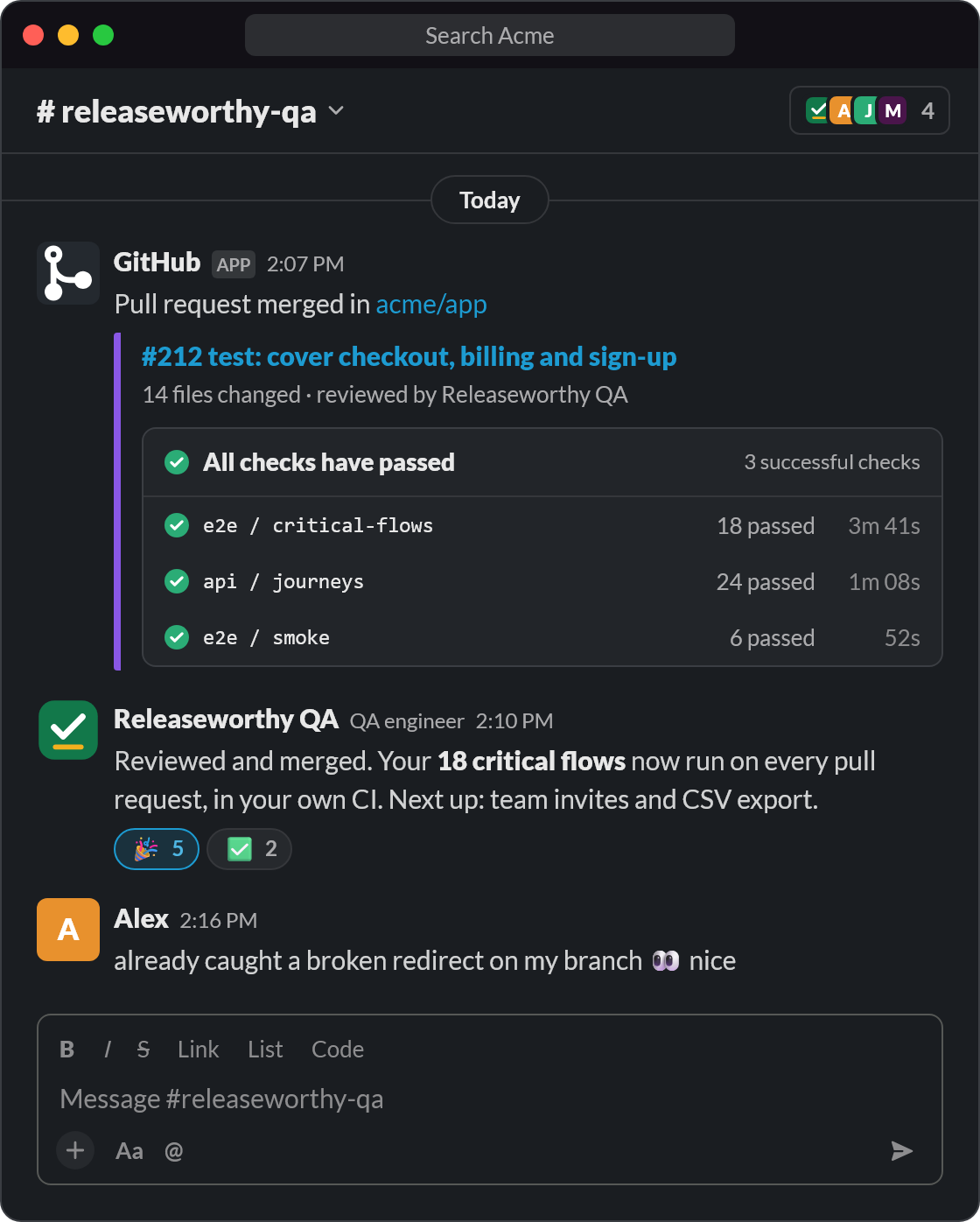
03Every release
A real bug gets a report with video, logs and steps to reproduce, and holds the release until it is fixed. A flaky test is traced and fixed, not muted. Then you get a signed Go or No-Go.
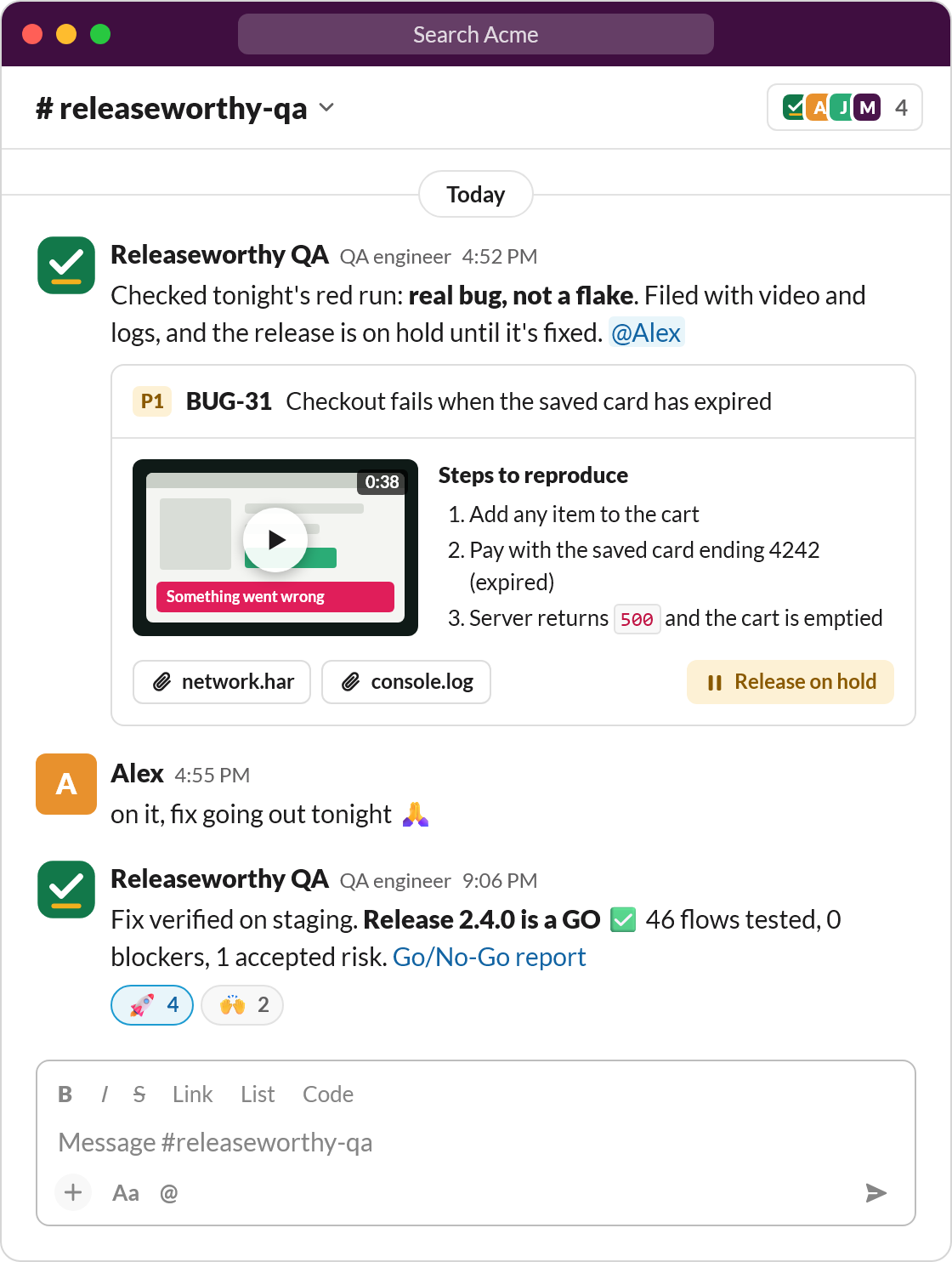
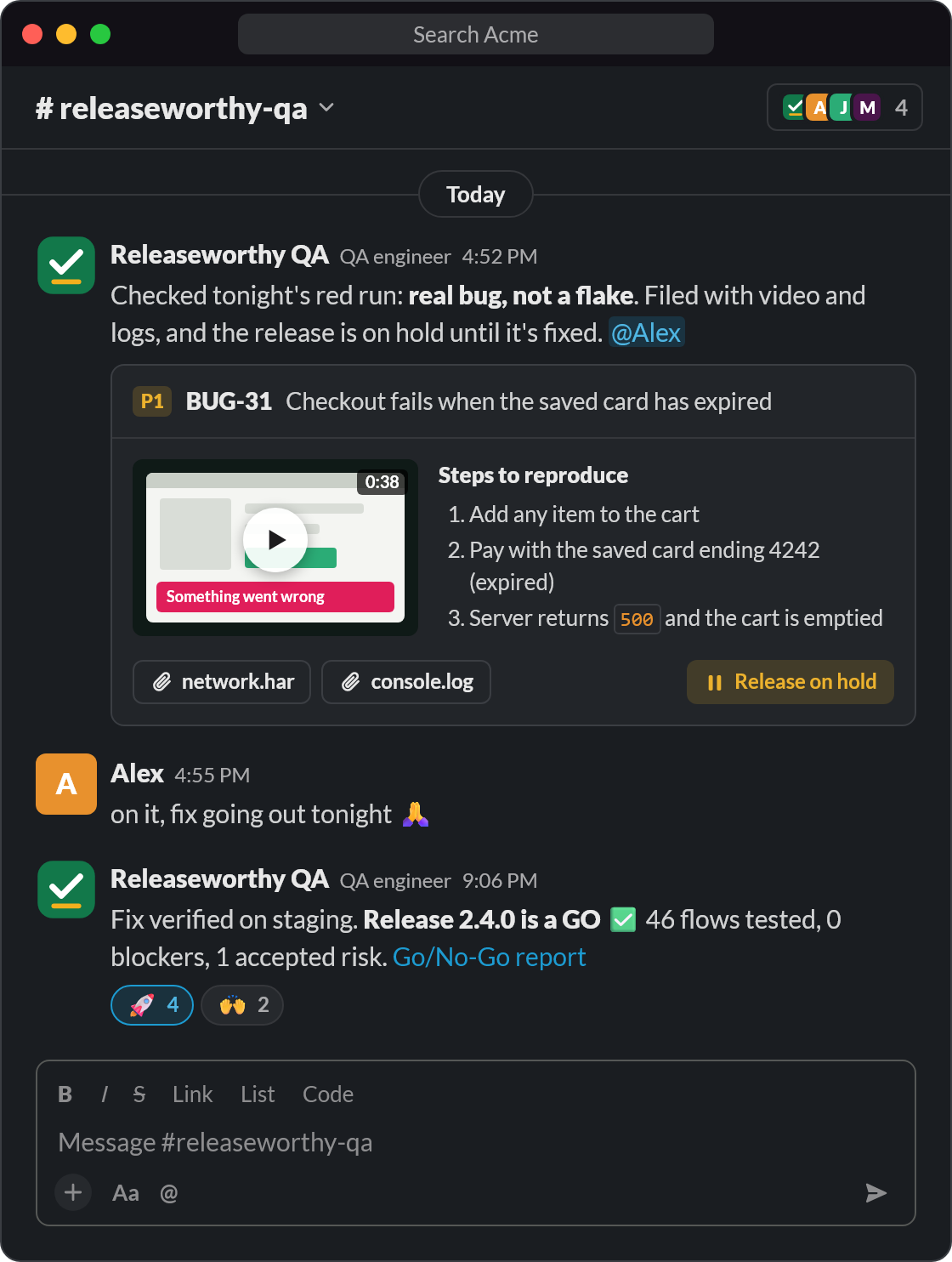
Illustrations with example messages, not a client conversation.
The 60-day pilot
US$1,000 a month for the first 60 days instead of US$2,000. The full service, success criteria agreed in writing, and every test stays yours if you stop.
Week 1
Access set up, your user flows ranked by risk, success criteria agreed in writing, and the first tests running in your CI.
Weeks 2 to 4
The flows that would hurt most if they broke run on every pull request, and a person reviews every failure.
Weeks 5 to 8
Exploratory testing of new features, a weekly digest in your chat and a Go/No-Go report before each release.
Day 60
We review the results against the success criteria with you. Continue at US$2,000 a month, or stop and keep everything.
Platforms
Not just the web. Tests are written in tools your team can read, maintain and keep after the service ends.
End-to-end tests in Playwright + TypeScript. Playwright Test runs tests in parallel across Chromium, Firefox and WebKit.
Tests for single endpoints and multistep journeys, written in TypeScript and run in the same pipeline as the web tests.
iOS and Android tests. We choose the framework that fits your app best:
Pricing
No fees per run, no AI credits, no hourly billing. A user flow is one end-to-end journey through your product, such as sign-up or checkout.
Start here
US$1,000per month
For the first 60 days, half price. Then US$2,000 a month if you continue.
The full service on your own product, so you can judge it on real releases.
US$2,000per month
Up to 500 user flows. Beyond that, US$4 per flow per month.
The whole QA job for one flat price, month-to-month.
Want to see our work first? Start with the Release Risk Audit: 5 working days on your product for US$490.
Proof you can inspect
agentic-qa is a public sample project: Claude agents doing the QA work on a demo shop we built. It has a test plan, Playwright + TypeScript tests for the API and the web app, bug triage and a live Go/No-Go report published from CI.
An honest note. The demo runs against a shop built for the purpose, so it shows how the work is done, not results for a client. There are no client logos or testimonials on this site. That is what the 60-day pilot is for: proof on your own product.
You do. The tests are committed to your repository and run in your CI, so they stay with you if the service ends.
No. The agents propose changes as pull requests. A QA engineer reviews every change before it is merged and owns every release call.
US$2,000 per month for up to 500 user flows, month-to-month. New clients start with a 60-day pilot at US$1,000 per month, half price. Beyond 500 flows, US$4 per flow per month. No hourly billing and no fees per run. See the pricing page.
With the 60-day pilot. Email us about your product. If it is a fit, you get a written proposal with a short video of how we would test your product. Then we agree the scope and the success criteria in a short written agreement, and the first tests run in your CI in week 1. Want to see our work first? Start with the Release Risk Audit: 5 working days for US$490, credited against the 60-day pilot if you continue (terms).
Yes. If you are still deciding after the proposal, or have questions it does not answer, we book a Google Meet call at a time that suits you, in your time zone. Ask for a call by email.
Cancel anytime; billing stops at the end of that month. You keep every test, plan and report, because they already live in your repository. There is nothing to export and nothing to unwind.
Yes. Web, API and mobile are all part of the same service. Mobile tests use Appium, Maestro or Mobilewright, and we choose the one that fits your app best.
Yours. We work in your time zone, and day-to-day talk happens in your team's chat, such as Slack, Discord or Telegram.
No. The agents are built with the Claude Agent SDK and run on Claude, an AI model made by Anthropic. Releaseworthy is independent and is not affiliated with or endorsed by Anthropic.
Blog
A Go/No-Go checklist for software releases: the criteria that matter, who makes the call, examples of No-Go conditions and a template to paste into your release ticket.
How AI agents do QA work with Playwright today: the loop, the tools (test agents, MCP, Agent SDK), where agents go wrong and the guardrails that work.
A QA checklist for each startup stage, from first customer to growing team, and an honest comparison of hiring, outsourcing, managed QA and AI tools.
One email is enough to start: your product, your platforms and how often you release. You get a plain answer on fit and, if it fits, a written proposal for the 60-day pilot with a short video of how we would test your product.
Or write to qa@releaseworthy.app. Still deciding after the proposal? We book a Google Meet call for your questions.